
Go Nuts For Coconuts
Leaf Letter vol.3

Bula!
I started writing this Leaf Letter while at the beach on a small postcard-worthy island in Fiji. It’s as magical as you’re imagining, with waves crashing gently on the shore, the sun hot and unobstructed, and coconut palms dancing in the breeze. There's a tiny newly sprouted palm next to me, perhaps from a nearby tree or perhaps brought in by the waves after spending many weeks at sea encased in its thick husk.
Upon arrival to this paradise, a book about coconuts on the free book swap table caught my eye while waiting to be checked-in. I had coconuts on the brain from our first stop in Fiji so this find sealed the deal as I discovered some very cool snippets that I’ll share with you further on. I also climbed a coconut palm later that day for fresh coconut water, though before you become too attracted to my athletic prowess, I'll admit there were steps cut in. I now had photos to share alongside my story. It was all coming together.
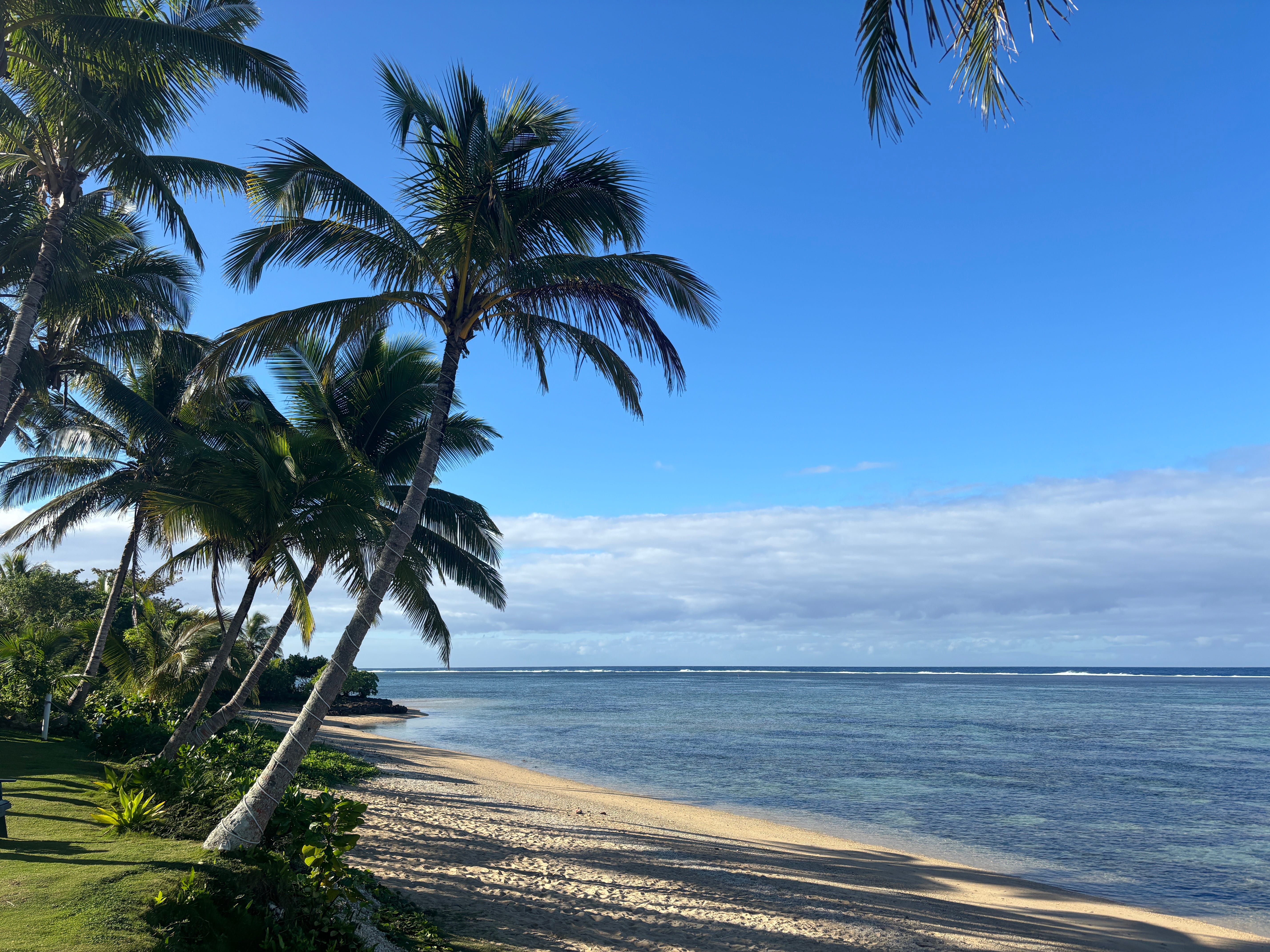
Now, coconut palms have an overwhelming amount of information on them, from health benefits to farming, culture, and construction. It feels never ending. In the Malay language, it is fittingly called pokok seribu guna "the tree of a thousand uses". This may seem fantastic, and it is, until you are attempting to write an interesting and concise story about them. Then, it’s a nightmare. I’ve chosen to share some things that jumped out at me, and hope they’ll be good spokespeople for the wonderous coconut.
If you’re like me, and from a country that doesn’t grow coconuts and only experiences them through body wash scents and bottled coconut water, it’s easy to see them as just a singular ultra versatile plant. While there is only one species, Cocos nucifera, there are over 80 varieties, often grouped by their heights: dwarf and tall. Some of these are amazing for coconut water, others for oils or for construction, and they’re spread across many parts of the world in tropical coastal areas. How they’re used in these places is also shaped by culture, resource needs, and consumer export demand for coconut fiends like me.
One of the surprising uses for coconut was cranioplasty. This is where the human skull is repaired using an alternative material. Evidence has been found that South Pacific populations used coconut shells to repair gaps in the skull, with shells being found in historic graves. It's hard to say how successful it was, but archaeologists have found that cranioplasty was performed in many ancient civilizations, with examples of indigenous surgeons in South America using materials such as gourds, shells, and gold and silver plates during 3000–2000 BC.
There are other medical uses that aren’t quite so extreme and are still relevant today. In Ayurvedic medicine, the oil, milk, cream and water of the coconut are all used to treat hair loss, burns and heart problems. These uses were documented in Sanskrit 4,000 years ago in India. Coconut water and kernels have numerous medicinal properties and micronutrients, making it a staple food in many tropical countries. Its reach has expanded globally, as I’m sure you’ve noticed, with coconut products available in most supermarkets and coconut water becoming a popular health drink in Western society.
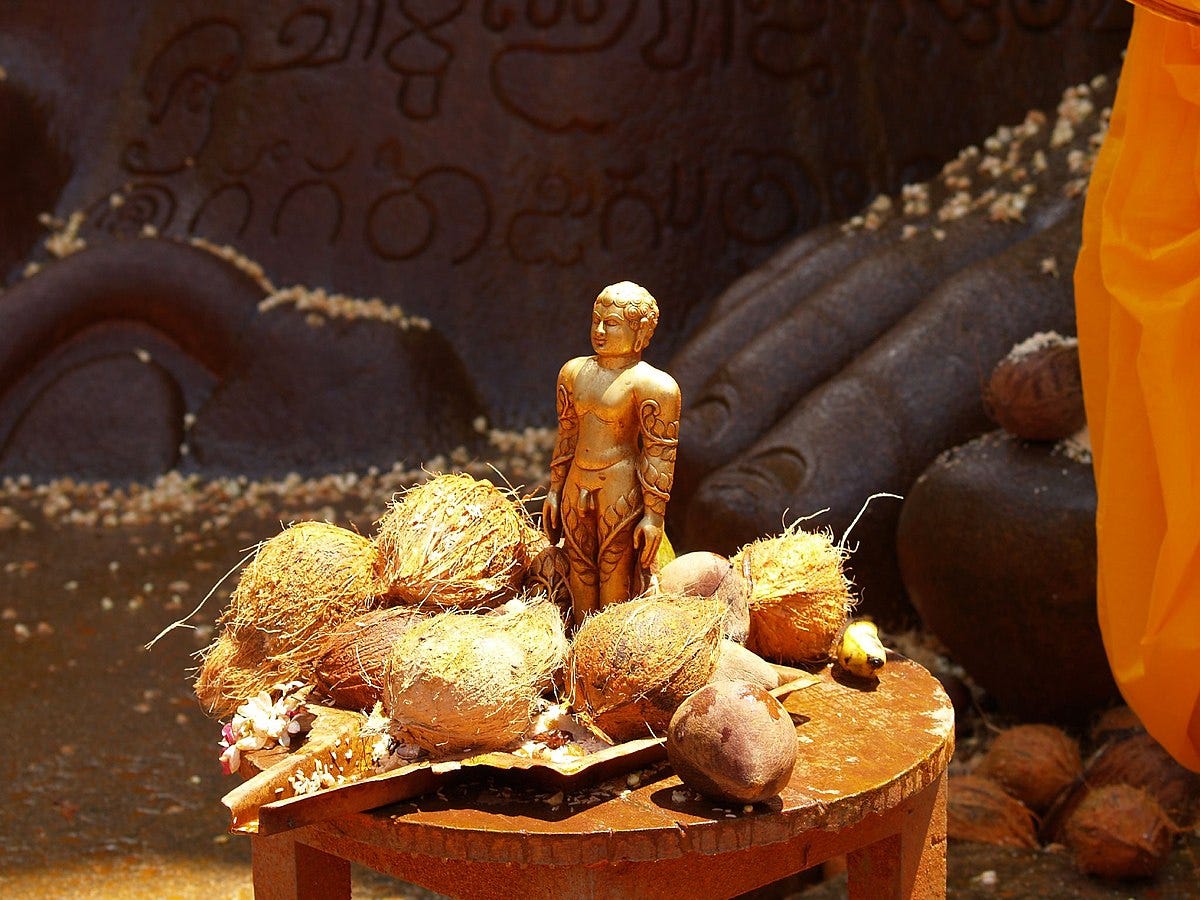
The coconut isn’t just a resource, it’s also important in symbolism and folklore. In parts of Africa, Asia, and the Pacific, the coconut palm represents birth, and a tree is planted for every newborn. In India, coconut is used in Hindu religious rites and forms an essential element of rituals and festivities. An example is a coconut being broken open as part of an inauguration for completed building projects and offering it to a god. This symbolises the act of offering oneself to attract prosperity.
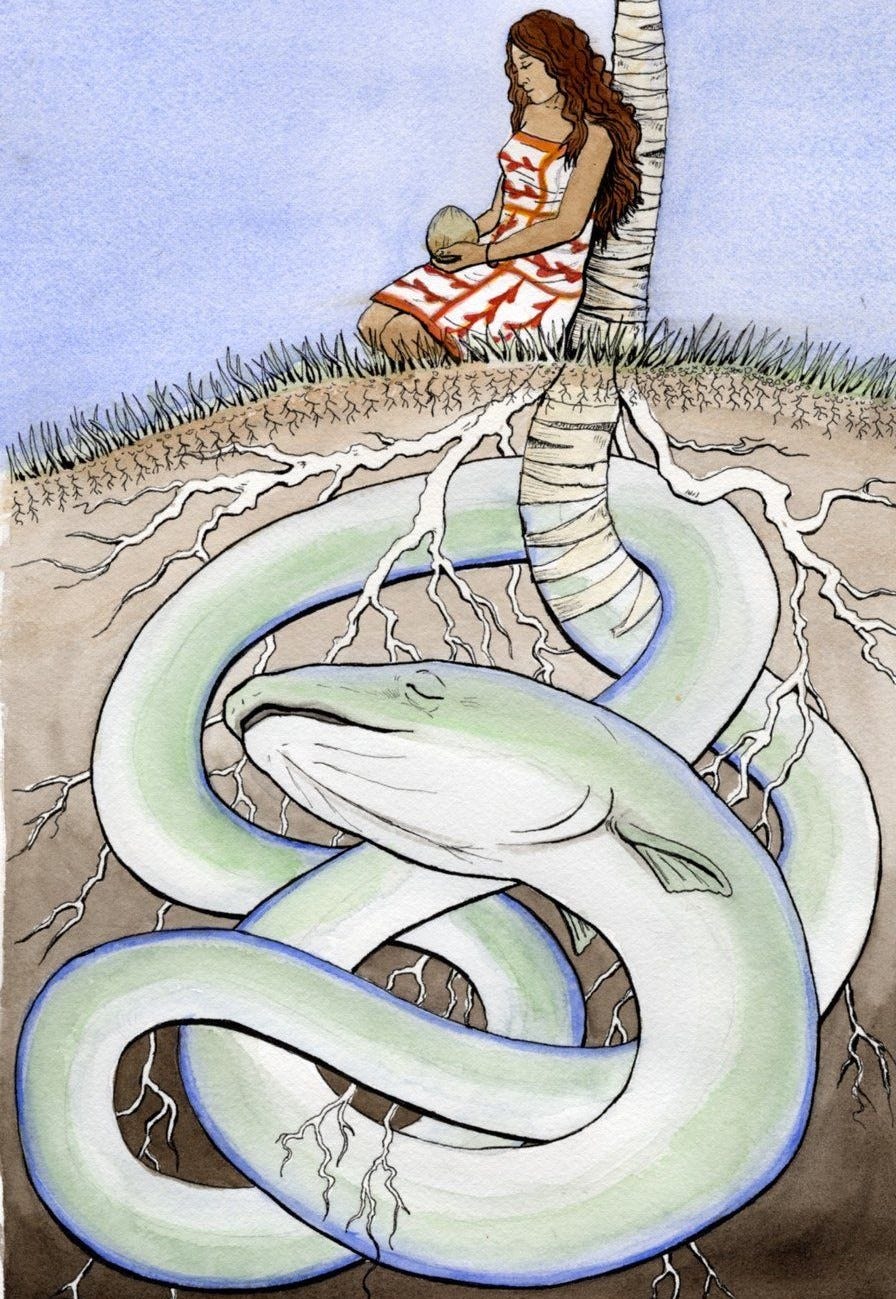
In Samoa, and other Polynesian cultures, there is an origin story about the first coconut tree called ‘Sina ma le Tuna’/‘Sina and the Eel’. In one version of this tale, Tui Fiti, the King of Fiji, heard of a breathtakingly beautiful girl named Sina and wanted to marry her. He used his magic to transform himself into an eel and swim the ocean currents to Sina’s village in Samoa. He waited in a bathing pool until Sina appeared and then showed himself to her, still in eel form. She enjoyed his friendly nature and made him her pet, unaware of his real identity. She cherished him as a pet and they lived happily together until he knew his time was up. Tui Fiti revealed who he was and that he had stayed an eel as he thought she would reject an old man like him if he had turned back into a human. For his dying wish, he asked Sina to cut off his head and bury it in the sand. She agreed as she had loved her pet, and from his buried head grew the first coconut tree. A tree of many uses, his gift to her. The coconut has three round marks on the husk resembling the face of the eel with two eyes and a mouth. One is pierced to drink from it, and so when Sina takes a drink, she is believed to be kissing the eel.
There are many more fun facts about this ‘tree of a thousand uses’ but I think this is enough to have your agreement that coconut palms are incredible and do so much for us. What I love most about them though, all impressive feats aside, is that everytime I’m around a coconut palm, I’m in a beautiful place, happy, sunkissed, and relaxed.
Leaf, laugh, love,
Amalia
Like, share and subscribe for more botanical stories. If you're interested in working with me, get in touch. I’d love to collaborate with you!
References
Ahuja, U. (2014). Coconut – History, uses, and folklore. Academia.edu. https://www.academia.edu/68473208/Coconut_History_Uses_and_Folklore
Alouw, J. C., & Chinthaka, A. H. N. (Eds.). (2025). The economic, social and environmental importance of coconut. In Science-based pest management for a sustainable and resilient coconut sector. Springer. https://doi.org/10.1007/978-3-031-84266-5_1
DebMandal, M., & Mandal, S. (2011). Coconut (Cocos nucifera L.: Arecaceae): In health promotion and disease prevention. Asian Pacific Journal of Tropical Medicine, 4(3), 241–247. https://doi.org/10.1016/S1995-7645(11)60078-3
Flanigan, P., Kshettry, V. R., & Benzel, E. C. (2014). World War II, tantalum, and the evolution of modern cranioplasty technique. Neurosurgical Focus, 36(4), Article E22. https://doi.org/10.3171/2014.2.FOCUS13552
Kew Royal Botanic Gardens. (n.d.). Cocos nucifera, coconut palm. https://www.kew.org/plants/coconut-palm
Library of Congress, Science Reference Section. (2019, November 19; updated 2024, May 1). Is a coconut a fruit, nut or seed? https://www.loc.gov/everyday-mysteries/agriculture/item/is-a-coconut-a-fruit-nut-or-seed/#:~:text=In%20the%2016th%20century%2C%20Sir,as%20far%20south%20as%20Madagascar
Marco, A., Ferrante, L., Pastore, F. S., Ramundo, E. O., Cantarelli, D., Scopelliti, D., & Iannetti, G. (2003). Bone autografting of the calvaria and craniofacial skeleton: Historical background, surgical results in a series of 15 patients, and review of the literature. Surgical Neurology, 60(1), 71–79. https://doi.org/10.1016/S0090-3019(03)00031-4
Samoa News Hub. (2023, April 10; updated 2025, June 28). Sina and the eel. https://samoanewshub.com/2023/04/10/sina-and-the-eel/#:~:text=The%20myth%20of%20origins%20known,and%20made%20it%20her%20pet
Images:
Pinterest/22052032
Matthew Logelin, CC BY 2.0 <https://creativecommons.org/licenses/by/2.0>, via Wikimedia Commons